Sunday, 21 February 2016

Key competencies in re-designing the HPSS science curriculum

I will start with a disclaimer: all of the (insanely hard!) work mentioned in this post was a huge collaborative effort from all of the awesome science team at HPSS (Cindy, Danielle, Cairan and Aaron), and took a fair few months to pull together, and we are still tweaking and modifying as time goes on. We have plans to document this journey and initial outcomes in more detail too, but this is just a preliminary overview of our pathway so far.

As part of a MindLab assignment, I have been asked to reflect on how I have developed in my own use of the key competencies, and key changes in my own practice. I have decided to use the most significant change in how I am teaching as an example of this, which I will outline below.

The material and ideas broached in the MindLab course reminded me that the mindset and approaches to teaching and learning that we follow at HPSS are already a long way ahead of many other secondary schools. This experience reinforced that we need to make the most of our special situation to push the boundaries even further and really question how we do things and why we do things the way we do. Therefore, my use of key competencies centred around thinking and relating to others.
Thinking is about using creative, critical, and metacognitive processes to make sense of information, experiences, and ideas. These processes can be applied to purposes such as developing understanding, making decisions, shaping actions, or constructing knowledge. Intellectual curiosity is at the heart of this competency.
Students who are competent thinkers and problem-solvers actively seek, use, and create knowledge. They reflect on their own learning, draw on personal knowledge and intuitions, ask questions, and challenge the basis of assumptions and perceptions. (NZ Curriculum)
My use of thinking involved bringing our experiences of teaching science over the last 2 years at HPSS, as well as making decisions based on critical thinking and questioning how we can further develop our science curriculum. We did this by reflecting on what we thought was going well, but also where there was room for improvement, as outlined below.
Relating to others is about interacting effectively with a diverse range of people in a variety of contexts. This competency includes the ability to listen actively, recognise different points of view, negotiate, and share ideas.
Students who relate well to others are open to new learning and able to take different roles in different situations. They are aware of how their words and actions affect others. They know when it is appropriate to compete and when it is appropriate to co-operate. By working effectively together, they can come up with new approaches, ideas, and ways of thinking. (NZ Curriculum)
Relating to others involved taking the experiences of all of our science team, and to be able to incorporate different ideas into a shared pathway forward. This wasn't a quick process, and it took a few iterations to go through the sharing and negotiating processes; but this time was vital to give everyone enough chance to process and think about where we wanted our take on the science curriculum to end up. 

Part of the impetus for change in the way we were teaching science at HPSS came about by a session from Grant Lichtman, who asked us to reflect on "simple rules" that we could apply to course design (this is the video of his visit also). This prompted us to think about what we envisaged a science graduate profile would look like - what do we want our students who take science through to the senior/qualification years to be able to do/think about/be?

The next step took us into the science capabilities for citizenship, as developed by the NZCER. The science capabilities can also be linked to the key competencies, as well as underpin what the Nature of Science is all about:
Key competencies are clusters of capabilities
The New Zealand Curriculum (NZC) defines key competencies as capabilities for living and lifelong learning.
Each key competency is a cluster of capabilities. Capabilities are things students learn to be able to do. But what do they need to be capable of? We need to keep learners’ futures in mind when working out answers to this question. (TKI)
The science capabilities themselves are placed into 5 categories:

  • Gather and interpret data
  • Use evidence
  • Critique evidence
  • Interpret representations
  • Engage with science
We have decided to streamline these for our own use, hopefully without removing meaning from them, but to assist us in figuring out how we may assess these - so focusing on:
  • Gather and Interpret Data
  • Use and Critique Evidence
  • Interpret Representations and Models
With our whole approach to teaching science allowing students to engage in science. 


So capabilities underpin the competencies, and in order to maximise student's exposure to develop these aspects of their learning, we needed to change the focus of our teaching - making the capabilities, and over time competencies, visible and explicit. We still need to teach the 'strands' of the science curriculum, but these become contexts through which students can develop their science capabilities - interweaving skills and knowledge, rather than teaching solely knowledge through 'topics'.

As mentioned, this is only a brief overview of changes we have made, with more to follow.... but we welcome questions and feedback!




Monday, 8 February 2016

New school year, new blog post (finally!)

My goodness, it has been a while since I have updated this poor blog.

That is not to say that I haven't spent the last few months exploring my teaching practice and being challenged and engaged in problem solving, in fact just the opposite: every day at HPSS requires thinking and engagement from the teachers as well as the students, you can't just rock up to class with some worksheets that you use every year in the same topic for that year level.

All modules are new because the students make them new - they give us the contexts and show the direction that we need to cater to, and so keeping only a few steps ahead of the students is always challenging, exciting and time consuming!

Tomorrow HPSS welcomes in a new cohort of year 9's - the third such cohort. I imagine that our spaces are going to start feeling more full, and possibly that the older students are in for a bit of a shock having to share their spaces and teachers with yet another year group. I am really looking forward to having 'senior' students (Qualification years) as well as 'junior' students (Foundation Years), and seeing how or if the students have changed over the last 6 weeks, as well as welcoming new students to our special school. I am grateful that I have met with every single student in my learning hub (14 of them), along with their parents last week - it makes me feel like I know all the newbies a bit already, and because they've met me and been in our learning community space, hopefully the first day of secondary school is less daunting for them than I know it was for me.

Over the next few blog posts, I hope to review some of the work I was involved with last year, as well as make some more directed reflections on specific issues relating to the MindLab course I am completing at the moment.

I am also part of the re-vamped Learning Design Leaders team at HPSS this year, representing the Science learning area, and so will endeavour to share some of the (EPIC! MASSIVE!) work our awesome science team has done to completely review and redesign the way that we teach science at HPSS (capabilities focus.... watch this space!)

Saturday, 9 May 2015

Inquiry into Inquiries...

As part of a MindLab postgrad course I am doing this year, one of the assessment series I have chosen to do is linked into how I approach the inquiry experiences that I set for students in my modules. Because we see more value in assessing students by how they inquire into their learning contexts, rather than giving them 'end of topic' tests or exams, we have not yet have our Y9 and Y10 students experience those periods of intense exam-week stress. I see this as being a valuable thing, and know that we will help our students prepare for when/if they choose to sit NCEA externals down the line - but not as a process of sitting an exam for exam's sake. Test/exam strategies are an important skill to learn, just like how to write a good essay, or how to solve algebra problems, or how to apply learning in a cross-curricular manner, but I really believe at a junior level, sitting lots of tests and exams does more harm than good.

I digress slightly! However, something that's been on my mind is that sometimes our students end up with multiple inquiries all being due at the same time (often the end of terms, when many modules have done some front-loading teaching and learning). This isn't always a problem, but for some students can cause them some stress. My MindLab assessments (and to be smart, my teaching as inquiry at the moment too!) is looking into what strategies and approaches I can change within my teaching practices in order to address this potential problem.

Below is the first part of my inquiry into inquiries ;) - just identifying the issue. Watch this space for the next parts, which are looking into what strategies I can use, and then finally how application of these strategies works.


Many thanks to the students who gave their honest feedback - and agreed for me to publish the video.

Sunday, 22 March 2015

Enabling constraints by scaffolding

I have come to really love the phrase 'enabling constraints'. It ties together so much of what I value in teaching: the ability to empower students with choice and freedoms by setting clear guidelines and high expectations. It also hints at the approach of 'warm and demanding' which we all aim to embody at HPSS.

For me, it also reminds me of Howard Gardner's Five Minds for the Future, which talks of bringing together the creative and disciplined mind:

                               "You can't think outside the box unless you have a box"


I have been reflecting lately that since coming to HPSS, I have become much more adept at scaffolding tasks for students (prompted by many of the other teachers I work with, but particularly Lisa and Cindy) - and have noticed just how much this has helped the students I work with to have a clear grasp of exactly what I expect from them.

In the past, I had just assumed that my students had somehow picked up the ability to write paragraphs and essays (by osmosis? from the English dept? probably not from physics?! - yes, I jest!)... but I never really took it upon myself to teach them how to communicate science ideas in a way that scientists most appreciate (and let's face it - NCEA markers appreciate). The content took so much time to teach that there was barely any time to talk about the Nature of Science, and certainly no time to teach about communicating in science. The end result was that I often gave copious amounts of repetitive feedback, which boiled down to: more content, more explanations, less waffle, don't repeat yourself, give named examples, why? how? when? etc.

I am so grateful to have an opportunity now to take ownership of teaching skills first before content (or alongside content, really), so that students can actually do something useful with the content when they learn about it. I have been focusing with my Year 9 class on introducing PEE(L) paragraphs - point, explanation, example/evidence (link) - using hexagons with connecting words to help them:


With year 10's I have been extending their paragraphs into essays by using a compare and contrast HOT map, then multiple PEEL paragraphs that are individually scaffolded. The below example looked at similarities and differences between wind- and insect-pollinated flowers:


The resultant essays have really impressed me, in terms of their responses being concise, full of content with explanations given for every point made, named examples or evidence and no waffle(!) Given that they are written by year 10's at the start of the year, I have full confidence that our skills over content approach is working well - students soak up the content BECAUSE they have something to do with it, they are not learning facts for the sake of it. The key thing has been that our PEEL paragraph approach last year with the now year 10 students was aligned across the board - all learning areas used it, so students had the chance to consolidate, test and refine their practice. Our students are not 'pigeon-holing' their learning, but rather they see where cross-curricular tools can be applied, and they use them to good effect.

I realise that English in particular has always taught students how to write essays, and I wonder why more subjects/learning areas don't? (unless this is purely my experience - a possibility!)

(I am more than happy to share hexagons docs - I have a set of connecting words, plus a set of compare and contrast words; and the docs with scaffolding, should anyone be interested).

Saturday, 7 February 2015

Lessons from jigsaw puzzles

A less-than-ideal weather situation while away for the long weekend lead to entertainment through jigsaw puzzles. Teaching analogies kept leaping at me off the table, and so I felt obliged to write some of them down.... as random as they might be!


  • Collaboration makes the whole thing easier
  • Don't assume you know where things fit at face value - don't judge before you see things in situ
  • Don't get stuck by only looking for one thing - move on and come back to it
  • Appearances can be deceiving
  • Expect the unexpected (we were doing a wasgij puzzle!)
  • The big picture is clearer when more details are in place
  • Resilience is a necessity
  • Patience and calm is needed to make progress
  • Some things immediately fit into place, others take much longer to work out
  • It can be very hard to find just one thing if you narrow your focus too much - being more open minded lets you make more progress
  • Be willing to be wrong
So what will I take from those ideas and apply to my teaching this term? 

I plan to let the students fill in some of the details for me - I have some vague/outlined plans in my head, but I can't put the puzzle together until I know what each student brings with them, and also what they want to learn about. 

The other thing in completing this 1000+ piece puzzle is that it took a good few hours to do, and there was no reward other than the task itself - but it retained (mostly!) interest as a satisfying and fun activity (especially as we didn't know what the end result would look like), and so motivation to complete it was intrinsically driven..... this also ties in nicely to Dan Pink's Drive which I have also been reading this weekend! A book that I have heard a lot about, and had secondhand information from, but have really needed to read myself to understand the messages on a deeper level (another teaching lesson - students need to DO not just hear about something to learn from it).


Wednesday, 26 November 2014

Preaching to the converted - re-affirmation from NZQA

I have attended a NZQA best practice workshop today with a generic focus on how we can collect evidence that supports 'natural evidence' of student learning as well as supporting cross-curricular/integrated learning that means students gain the maximum number of credits for their learning, where it authentically matches: allowing student learning to go deeper by 'double-dipping' rather than over-assessing where students are being assessed multiple times for very similar learning content/contexts.

It has been a very affirming experience that HPSS is on the right track - a track that is strongly supported by NZQA. It has also reminded me of the blockades that teachers themselves, departments and schools are maintaining as resistance to change, and instead of asking "how might we?" (thanks @maurieabraham ), there are still strong arguments that shut down opportunity for student-centred assessment by sticking with low-trust models of assessment that let authenticity worries drive the assessment design overall.

Some of the key questions I have pondered today:

  • How do we assess for flexibility, innovation and student focus, while still retaining rigour and manageability? 
  • How to provide multiple opportunities to different students for the same AS, while still being manageable from a teaching point of view? How can we support students to choose their own mode of assessment?
  • How to find rigorous assessment opportunities that authentically support more than one learning area?
Some of the ideas that have been fed back from what students and NZQA value:
  • more time = higher engagement
  • choice of practical work, not just lots of writing
  • transparent guidelines
  • unpacking exemplars is a vital component of teaching
  • feedback/feedforward during assessment phase - gives a chance for students to improve and show their best work
  • the relationship between student and teacher is so important, and this combined with a portfolio approach can help to address authenticity issues
  • the context and content need to be meaningful - use "double dipping" where possible to allow student learning to go deeper, not just collecting credits
  • Not everything will mash-up in an authentic way - there needs to be rigour and a non-forced match between achievement standards.
Ideas about naturally-occurring evidence, and how it relates to HPSS:
  • this type of evidence is a perfect mash-up for project learning… I can already see how this is going to work to allow credits to "fall out of" the learning that is already taking place
  • there still needs to be rigour via rubric and captured evidence that occurs during project/module and not one assessment event at the end.
  • evidence cannot be retrospective - it must be purposeful and captured at the time of the event, we need to be able to authenticate the learning that took place at the time of the event.
  • this aspect of evidence collection is really important in terms of front end of curriculum
  • this allows us to have the ability to assess process of learning, not just the end product - this can help towards numeracy and literacy.
  • the formality of evidence still needs to be there - robust documentation - we must be able to see what students have done to be able to make professional judgements on performance/grade
  • this means that achievement standards can “fall out of” work done during projects.
So overall, a really positive view that HPSS is on the right track and that we can definitely find ways to let the learning drive the assessment as we get into years 11 and beyond, and not the other way around.


Thursday, 25 September 2014

Learning curves - my first term at HPSS

So Term 3 is rapidly coming to a close, and it feels like the right time to reflect on some of the lessons learned this first term for me at Hobsonville Point Secondary School.

I came here mid-year, leaving behind some really wonderful colleagues and students (who I still miss quite a bit!), knowing that HPSS did things differently, and feeling really excited about trying new ways of doing things & being able to learn professionally from a whole heap of amazing educators. It hasn't been as overwhelming as I thought it might be - partly because I had been following the happenings and progress at HPSS through friends and through blogs like Steve's, Claire's, Danielle's and Maurie's (to name but a few - how cool that so many HPSS teachers are documenting their journeys in this way!) - so I had a reasonable idea about how things were structured, although obviously not a complete understanding of everything. Most of all, I have learned so much from other learning area teachers, have been blown away by some of the work students have produced, and have had the opportunity to re-assess what the really vital parts of the science curriculum are.

Below I've commented on some of the things I've learned about just two aspects of the school this term (sorry in advance for the novel, more still to come later!):

Learning Modules:
I have taught on two combined modules - a Big Learning Module (BLM - three combined learning areas: English, Social Science and Science), and a Small Learning Module (SLM - two combined learning areas: Design - Visual Communication and Science). I have also taken an Active Recreation Module (AR - yoga).

By teaching combined learning areas, I have picked up on many strategies, techniques and approaches that I usually wouldn't have exposure to - one of the best is from English (and is actually a school-wide effort) in using PEEL paragraphs (Point, Explanation, Example, Link) to present ideas. Without recognising it, I had already seen this structure as an essential part of writing science answers in NCEA, and so by teaching this explicitly from early on, skills developed now will be incredibly useful later on.

I have also learned that in order to make the most of the time I have with the students that I need to teach less better - so focusing on the vital aspects of each part of the science curriculum - this term has had a Nature of Science - participating & contributing emphasis - namely lending itself to socio-scientific issues. The skills involved in being able to deeply understand an issue have included exploring different perspectives (political, De Bono's hats, Kaplans tools, individual), the difference between an opinion and evidence-based conclusions, being able to identify reliable and accurate sources of information (CRAP detection), and science research skills generally.

As an aside, I've been reading some of Richard Feynman's semi-autobiographical writings which provide quite an amazing insight into the mind of such an innovative and creative person & scientist. One reflection of his deals with his time in a biology lab and the outsider's view that he had of this as a physicist. A blog within Scientific American comments on this cross-curricular type experience of his (far better than I could!):
One of the most exciting parts of interdisciplinary research and of art-science collaborations is the questions that smart and curious people ask when they’re encountering a new field, the things that stick out when viewed from a different perspective. These kinds of questions might sometimes seem naive or even arrogant, but at their best they can point towards new directions where no one knows the answer and everyone ends up seeing something differently. Feynman’s great talent was to show us the universe–and the wonder and tedium of life in the biology lab–through a physicist’s eyes.
I co-incidentally read this as I was starting to reflect on what I have learned this term, and the sentiment of learning with 'new eyes' seems very apt - it also ties into the very name of my blog - teaching with a beginner's mind - and the idea that only through questioning what is often status quo can we view things with a different perspective that can often provide a new pathway.

I have learned too that missing senior students means that sometimes you get a bit over-excited, and want to do too much with students who think & talk like senior students (really great thinking skills) - but don't yet have the content knowledge or dispositions of senior students (as you would totally expect for year 9's!) - and so sometimes I have verged into overstimulation territory by trying to do too much at once rather than focus on what is really important. I know from what other HPSS teachers tell me that this is par for the course in my first term, and second and third time around you get a clearer understanding of what the focus needs to be.

One last piece of learning is that my PE-classroom management skills are not completely up to scratch! I have found that trying to manage students in the gym for yoga is a completely different kettle of fish to my usual teaching environment...

Learning Hubs:
This is the aspect I have found has had the the largest learning curve for me. It is certainly like a tutor group/form class on steroids, and I really value the relationships that I am developing with my small group of students. I won't say it hasn't been challenging however, as the relationships I am forming are similar to those you normally have with more senior students - year 12 or 13, and ones that naturally form over 4-5 years of knowing those students - an organic process. To develop a coach/mentor/daily support role with my year 9 students in just 10 weeks has certainly not been the easiest process, but I feel that we have come along leaps and bounds already and I appreciate it when my students have commented how surprised they feel that I have only been there 10 weeks, as it seems much longer to them. The fact that I know what things I want to try differently next term shows me how much I've learned already.

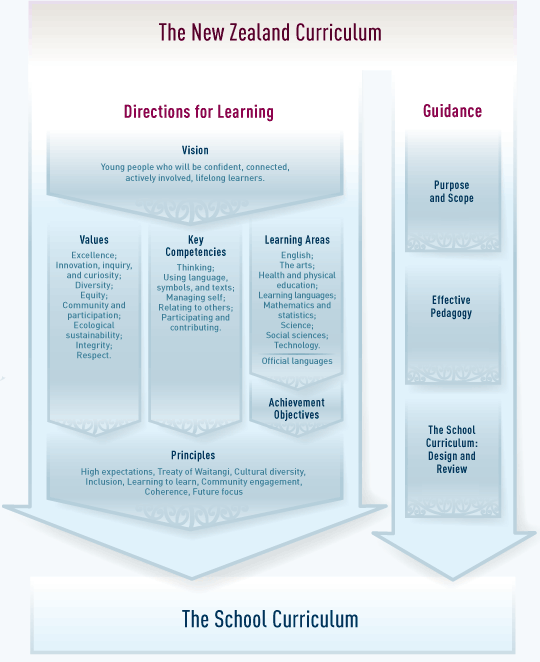
The hub structure is an essential part of HPSS, and I can see clearly how it will provide students with a really solid 'home base' that can support them as they move throughout the school over the next few years. It also allows students to explore the aspects of the NZ Curriculum that are too frequently overlooked: To develop confident, connected lifelong learners who are actively involved; and to also explore our Hobsonville Habits:
http://nzcurriculum.tki.org.nz/extension/tki-nzc/design/tki-nzc/images//content/overview.png
http://sallyhart72.files.wordpress.com/2014/02/hobsonville-habits.jpg
So overall, I'm loving the new experiences and while (like all teachers!) I welcome the holiday over the next two weeks, I have a plethora of new ideas and plans to try next term. More than anything, I'm very grateful to all of the HPSS team that have welcomed me so warmly, and to the students who have re-defined to me what being a year 9 is all about.