Sunday, 22 March 2015

Enabling constraints by scaffolding

I have come to really love the phrase 'enabling constraints'. It ties together so much of what I value in teaching: the ability to empower students with choice and freedoms by setting clear guidelines and high expectations. It also hints at the approach of 'warm and demanding' which we all aim to embody at HPSS.

For me, it also reminds me of Howard Gardner's Five Minds for the Future, which talks of bringing together the creative and disciplined mind:

                               "You can't think outside the box unless you have a box"


I have been reflecting lately that since coming to HPSS, I have become much more adept at scaffolding tasks for students (prompted by many of the other teachers I work with, but particularly Lisa and Cindy) - and have noticed just how much this has helped the students I work with to have a clear grasp of exactly what I expect from them.

In the past, I had just assumed that my students had somehow picked up the ability to write paragraphs and essays (by osmosis? from the English dept? probably not from physics?! - yes, I jest!)... but I never really took it upon myself to teach them how to communicate science ideas in a way that scientists most appreciate (and let's face it - NCEA markers appreciate). The content took so much time to teach that there was barely any time to talk about the Nature of Science, and certainly no time to teach about communicating in science. The end result was that I often gave copious amounts of repetitive feedback, which boiled down to: more content, more explanations, less waffle, don't repeat yourself, give named examples, why? how? when? etc.

I am so grateful to have an opportunity now to take ownership of teaching skills first before content (or alongside content, really), so that students can actually do something useful with the content when they learn about it. I have been focusing with my Year 9 class on introducing PEE(L) paragraphs - point, explanation, example/evidence (link) - using hexagons with connecting words to help them:


With year 10's I have been extending their paragraphs into essays by using a compare and contrast HOT map, then multiple PEEL paragraphs that are individually scaffolded. The below example looked at similarities and differences between wind- and insect-pollinated flowers:


The resultant essays have really impressed me, in terms of their responses being concise, full of content with explanations given for every point made, named examples or evidence and no waffle(!) Given that they are written by year 10's at the start of the year, I have full confidence that our skills over content approach is working well - students soak up the content BECAUSE they have something to do with it, they are not learning facts for the sake of it. The key thing has been that our PEEL paragraph approach last year with the now year 10 students was aligned across the board - all learning areas used it, so students had the chance to consolidate, test and refine their practice. Our students are not 'pigeon-holing' their learning, but rather they see where cross-curricular tools can be applied, and they use them to good effect.

I realise that English in particular has always taught students how to write essays, and I wonder why more subjects/learning areas don't? (unless this is purely my experience - a possibility!)

(I am more than happy to share hexagons docs - I have a set of connecting words, plus a set of compare and contrast words; and the docs with scaffolding, should anyone be interested).

Saturday, 7 February 2015

Lessons from jigsaw puzzles

A less-than-ideal weather situation while away for the long weekend lead to entertainment through jigsaw puzzles. Teaching analogies kept leaping at me off the table, and so I felt obliged to write some of them down.... as random as they might be!


  • Collaboration makes the whole thing easier
  • Don't assume you know where things fit at face value - don't judge before you see things in situ
  • Don't get stuck by only looking for one thing - move on and come back to it
  • Appearances can be deceiving
  • Expect the unexpected (we were doing a wasgij puzzle!)
  • The big picture is clearer when more details are in place
  • Resilience is a necessity
  • Patience and calm is needed to make progress
  • Some things immediately fit into place, others take much longer to work out
  • It can be very hard to find just one thing if you narrow your focus too much - being more open minded lets you make more progress
  • Be willing to be wrong
So what will I take from those ideas and apply to my teaching this term? 

I plan to let the students fill in some of the details for me - I have some vague/outlined plans in my head, but I can't put the puzzle together until I know what each student brings with them, and also what they want to learn about. 

The other thing in completing this 1000+ piece puzzle is that it took a good few hours to do, and there was no reward other than the task itself - but it retained (mostly!) interest as a satisfying and fun activity (especially as we didn't know what the end result would look like), and so motivation to complete it was intrinsically driven..... this also ties in nicely to Dan Pink's Drive which I have also been reading this weekend! A book that I have heard a lot about, and had secondhand information from, but have really needed to read myself to understand the messages on a deeper level (another teaching lesson - students need to DO not just hear about something to learn from it).


Wednesday, 26 November 2014

Preaching to the converted - re-affirmation from NZQA

I have attended a NZQA best practice workshop today with a generic focus on how we can collect evidence that supports 'natural evidence' of student learning as well as supporting cross-curricular/integrated learning that means students gain the maximum number of credits for their learning, where it authentically matches: allowing student learning to go deeper by 'double-dipping' rather than over-assessing where students are being assessed multiple times for very similar learning content/contexts.

It has been a very affirming experience that HPSS is on the right track - a track that is strongly supported by NZQA. It has also reminded me of the blockades that teachers themselves, departments and schools are maintaining as resistance to change, and instead of asking "how might we?" (thanks @maurieabraham ), there are still strong arguments that shut down opportunity for student-centred assessment by sticking with low-trust models of assessment that let authenticity worries drive the assessment design overall.

Some of the key questions I have pondered today:

  • How do we assess for flexibility, innovation and student focus, while still retaining rigour and manageability? 
  • How to provide multiple opportunities to different students for the same AS, while still being manageable from a teaching point of view? How can we support students to choose their own mode of assessment?
  • How to find rigorous assessment opportunities that authentically support more than one learning area?
Some of the ideas that have been fed back from what students and NZQA value:
  • more time = higher engagement
  • choice of practical work, not just lots of writing
  • transparent guidelines
  • unpacking exemplars is a vital component of teaching
  • feedback/feedforward during assessment phase - gives a chance for students to improve and show their best work
  • the relationship between student and teacher is so important, and this combined with a portfolio approach can help to address authenticity issues
  • the context and content need to be meaningful - use "double dipping" where possible to allow student learning to go deeper, not just collecting credits
  • Not everything will mash-up in an authentic way - there needs to be rigour and a non-forced match between achievement standards.
Ideas about naturally-occurring evidence, and how it relates to HPSS:
  • this type of evidence is a perfect mash-up for project learning… I can already see how this is going to work to allow credits to "fall out of" the learning that is already taking place
  • there still needs to be rigour via rubric and captured evidence that occurs during project/module and not one assessment event at the end.
  • evidence cannot be retrospective - it must be purposeful and captured at the time of the event, we need to be able to authenticate the learning that took place at the time of the event.
  • this aspect of evidence collection is really important in terms of front end of curriculum
  • this allows us to have the ability to assess process of learning, not just the end product - this can help towards numeracy and literacy.
  • the formality of evidence still needs to be there - robust documentation - we must be able to see what students have done to be able to make professional judgements on performance/grade
  • this means that achievement standards can “fall out of” work done during projects.
So overall, a really positive view that HPSS is on the right track and that we can definitely find ways to let the learning drive the assessment as we get into years 11 and beyond, and not the other way around.


Thursday, 25 September 2014

Learning curves - my first term at HPSS

So Term 3 is rapidly coming to a close, and it feels like the right time to reflect on some of the lessons learned this first term for me at Hobsonville Point Secondary School.

I came here mid-year, leaving behind some really wonderful colleagues and students (who I still miss quite a bit!), knowing that HPSS did things differently, and feeling really excited about trying new ways of doing things & being able to learn professionally from a whole heap of amazing educators. It hasn't been as overwhelming as I thought it might be - partly because I had been following the happenings and progress at HPSS through friends and through blogs like Steve's, Claire's, Danielle's and Maurie's (to name but a few - how cool that so many HPSS teachers are documenting their journeys in this way!) - so I had a reasonable idea about how things were structured, although obviously not a complete understanding of everything. Most of all, I have learned so much from other learning area teachers, have been blown away by some of the work students have produced, and have had the opportunity to re-assess what the really vital parts of the science curriculum are.

Below I've commented on some of the things I've learned about just two aspects of the school this term (sorry in advance for the novel, more still to come later!):

Learning Modules:
I have taught on two combined modules - a Big Learning Module (BLM - three combined learning areas: English, Social Science and Science), and a Small Learning Module (SLM - two combined learning areas: Design - Visual Communication and Science). I have also taken an Active Recreation Module (AR - yoga).

By teaching combined learning areas, I have picked up on many strategies, techniques and approaches that I usually wouldn't have exposure to - one of the best is from English (and is actually a school-wide effort) in using PEEL paragraphs (Point, Explanation, Example, Link) to present ideas. Without recognising it, I had already seen this structure as an essential part of writing science answers in NCEA, and so by teaching this explicitly from early on, skills developed now will be incredibly useful later on.

I have also learned that in order to make the most of the time I have with the students that I need to teach less better - so focusing on the vital aspects of each part of the science curriculum - this term has had a Nature of Science - participating & contributing emphasis - namely lending itself to socio-scientific issues. The skills involved in being able to deeply understand an issue have included exploring different perspectives (political, De Bono's hats, Kaplans tools, individual), the difference between an opinion and evidence-based conclusions, being able to identify reliable and accurate sources of information (CRAP detection), and science research skills generally.

As an aside, I've been reading some of Richard Feynman's semi-autobiographical writings which provide quite an amazing insight into the mind of such an innovative and creative person & scientist. One reflection of his deals with his time in a biology lab and the outsider's view that he had of this as a physicist. A blog within Scientific American comments on this cross-curricular type experience of his (far better than I could!):
One of the most exciting parts of interdisciplinary research and of art-science collaborations is the questions that smart and curious people ask when they’re encountering a new field, the things that stick out when viewed from a different perspective. These kinds of questions might sometimes seem naive or even arrogant, but at their best they can point towards new directions where no one knows the answer and everyone ends up seeing something differently. Feynman’s great talent was to show us the universe–and the wonder and tedium of life in the biology lab–through a physicist’s eyes.
I co-incidentally read this as I was starting to reflect on what I have learned this term, and the sentiment of learning with 'new eyes' seems very apt - it also ties into the very name of my blog - teaching with a beginner's mind - and the idea that only through questioning what is often status quo can we view things with a different perspective that can often provide a new pathway.

I have learned too that missing senior students means that sometimes you get a bit over-excited, and want to do too much with students who think & talk like senior students (really great thinking skills) - but don't yet have the content knowledge or dispositions of senior students (as you would totally expect for year 9's!) - and so sometimes I have verged into overstimulation territory by trying to do too much at once rather than focus on what is really important. I know from what other HPSS teachers tell me that this is par for the course in my first term, and second and third time around you get a clearer understanding of what the focus needs to be.

One last piece of learning is that my PE-classroom management skills are not completely up to scratch! I have found that trying to manage students in the gym for yoga is a completely different kettle of fish to my usual teaching environment...

Learning Hubs:
This is the aspect I have found has had the the largest learning curve for me. It is certainly like a tutor group/form class on steroids, and I really value the relationships that I am developing with my small group of students. I won't say it hasn't been challenging however, as the relationships I am forming are similar to those you normally have with more senior students - year 12 or 13, and ones that naturally form over 4-5 years of knowing those students - an organic process. To develop a coach/mentor/daily support role with my year 9 students in just 10 weeks has certainly not been the easiest process, but I feel that we have come along leaps and bounds already and I appreciate it when my students have commented how surprised they feel that I have only been there 10 weeks, as it seems much longer to them. The fact that I know what things I want to try differently next term shows me how much I've learned already.

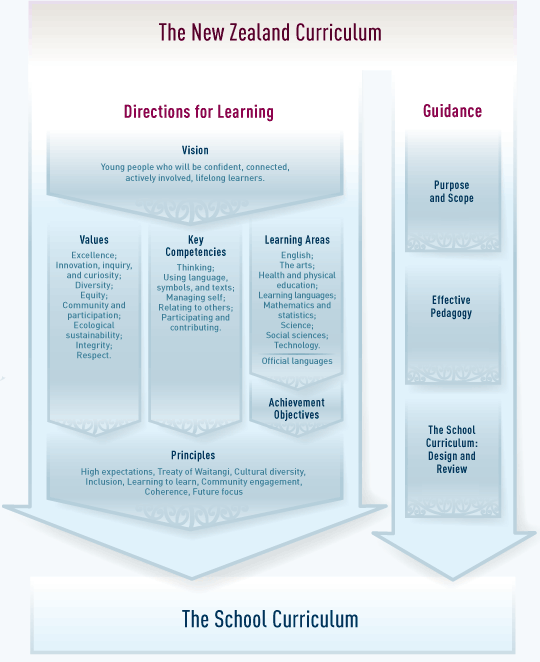
The hub structure is an essential part of HPSS, and I can see clearly how it will provide students with a really solid 'home base' that can support them as they move throughout the school over the next few years. It also allows students to explore the aspects of the NZ Curriculum that are too frequently overlooked: To develop confident, connected lifelong learners who are actively involved; and to also explore our Hobsonville Habits:
http://nzcurriculum.tki.org.nz/extension/tki-nzc/design/tki-nzc/images//content/overview.png
http://sallyhart72.files.wordpress.com/2014/02/hobsonville-habits.jpg
So overall, I'm loving the new experiences and while (like all teachers!) I welcome the holiday over the next two weeks, I have a plethora of new ideas and plans to try next term. More than anything, I'm very grateful to all of the HPSS team that have welcomed me so warmly, and to the students who have re-defined to me what being a year 9 is all about.

Sunday, 17 August 2014

The uncomfortableness of learning

One of the incredible opportunities of teaching in a cross-curricular, modular-based format at HPSS is that there is the chance to approach everything the students learn with real purpose. Focusing on doing less, better; emphasising a deep skill base in these early secondary years, rather than rote-learning facts that google could have showed them (NB: I am not saying that there is no need for content teaching - especially in science as there are many misconceptions to avoid - however I deeply believe that skills are an immensely valuable part of science, too often skipped over. See here for an earlier post on this).

So over the last couple of weeks, in my Small Module (Transport Us - a combo of science & design-visual communication that I'm teaching alongside the fab Liz - in which students explore things like designing their own vehicle, being informed by the science of fuel sources, using evidence to form opinions and make decisions) I had the chance to incorporate some physics into the module.

Initially I wanted to 'do' a friction experiment with them, because I could see how relevant the links would be between friction and their vehicle design, but the idea and planning never sat well with me, and as the time approached (incidentally also the day HPSS had 300 educators join us for the #edchatnz conference), I decided to ditch the lesson plan in favour of a more deep & robust (but slower) option - exploring forces first, then giving students the choice of which force they wanted to look into further.

This last week we continued our exploration, as students had decided on 'their' forces - and I asked them to continue with their planning... this wasn't the 'fun stuff' they had expected (playing with paper aeroplanes, rubber bands, balls, water and forcemeters), but I explained just how important the skill of being able to plan & write their own methods/approach was, and so they graciously took up the challenge....

... It was a very challenging lesson though - to ask these year 9 students to come up with their own question/aim, decide on variables and write a method from scratch - they found it hard, and to be honest the lesson didn't have that 'feel good' factor that you sometimes get. I came away to lunch feeling a bit disheartened that they had found the task so hard, and it hadn't felt satisfying. The wonderful Lea @leavellenoweth pointed out that she had also been placing emphasis on the importance of planning before the 'fun stuff' in her English module about developing passion projects, and also reminded me that the feeling of being uncomfortable and outside of your comfort zone means that you are learning! 

I went back after lunch and pointed this out to students, also letting them know that usually at a Year 9 level, it would be far more common for them to be given a method to follow - recipe-like - and to not have to devise the whole thing by themselves. However, as I wrote about in this earlier post about method-writing - I strongly believe that we have to stop giving students pre-formed instructions, and just let them figure it out for themselves when the stakes are not high. It is too late to leave this skill-development until Y11 or Y12 when NCEA comes into play, and the stresses of getting things right are much higher.

My plan is to give them some feedforward on their methods before our next lesson, and then get them to carry out these experiments, making notes where their methods weren't detailed or accurate enough, and then re-write, and give to another student to see what the peer-feedback is, whether someone else could follow their method.

Yes, it will take (much!) longer than giving them a recipe, but my hope is that they gain something far more valuable than just being able to jump into the 'fun stuff' without a second thought about the why, how and what. And who says planning isn't also fun?! ;)


Things lost in becoming a teacher

Two years ago, I was part of a panel that talked to 2nd and 3rd year University of Auckland health science students at a careers evening. I was the sole representative from the education sector, but also talked to students about my pathway to teaching, including a doctorate, and post-doctoral research in industry (rather than staying in academia). While many questions from students focused on how I got a job post-study, and what the process of a PhD was like, there were a couple of questions about teaching, and one specifically that I hadn't expected:

"what skills & approaches that you developed during your career as a researcher were transferrable to teaching?"
At the time (after feeling stumped and saying what a good question it was!) I replied that to be honest, I couldn't think of many that were that transferrable, mostly because as a researcher you have to be very self-confident with quite a large ego - after all, it is your belief in your own work that drives the experiments that you do (or ask others to do) - it is this belief in yourself that leads to grants being applied for, connections made to other research groups' work and the ability to get through the daily slog of many experiments not working, data not quite matching, until you occasionally get those incredible break-through moments.

Whereas in teaching, there is no place for ego, no place to believe that you are more important than the students in your classroom - after all, the students are the whole reason you are there, and they must take priority over how great you may think you are.

If I were to answer the question now, I would answer the same way about ego, but I do now recognise that many skills I developed during my time as a researcher are so vital to my teaching. Below are just a couple of skills that I believe I gained through research, but now I see are skills we are trying to teach at school (which is pretty amazing!)


  • Critical thinking: Secondary school in my day was truly about rote learning and being right or wrong, and the critical thinking skills that I appreciate now, I certainly didn't develop until postgraduate study. 
  • Resilience: This is certainly something that was built through years of less-than-amazing experimental results (but let's keep doing it anyway, because we believe that the amazing data is just beyond our grasp!)
  • Problem-solving: I pride myself in having a 'number-8-wire' approach to tacking problems, and through having to solve my own practical/experimental setup issues myself, I know how to think laterally around a problem.

So all up, becoming a teacher has resulted in the loss of the 'luxury' of being able to focus so deeply on one specific area of cutting-edge knowledge and understanding (although it certainly didn't feel like a luxury at the time - in fact I still feel being a researcher is an incredibly tough career choice, especially for women.... but that's another post!), the main thing I have lost in becoming a teacher is my ego.... something that drives research but can't drive a classroom.

Love this image I stumbled across, especially with the NZ focus (from http://www.warriorteambuilding.com/ ).....
Source: http://www.warriorteambuilding.com/sources-of-knowledge/blog/mana-vs-ego-what-to-do-with-leaders-who-have-a-big-fat-ego/

postscript: I want to clarify that ego in research really is necessary, otherwise nothing would get done, no-one would have the confidence to believe that their research could make the difference and to continue despite setbacks. This isn't to say that every researcher is an ego-maniac, simply that the very process of being so closely focused on one small area of work (for which you may be the only person on the planet who is looking into that particular area of interest) leads to (necessary) ego forming.

Sunday, 27 July 2014

Putting my ideas & words into action or week One at HPSS

So my good intentions last term of keeping up with blogging about #hackyrclass were overtaken by the madness that was leaving my teaching position to take up a new one at Hobsonville Point Secondary school - a new school (in all senses of the word). So while I was still vaguely attempting to keep up with the amazing challenge that was #hackyrclass, the administration side of changing schools took preference (as these things have to from time to time!)

@ClaireAmosNZ made a pertinent point as #hackyrclass wrapped up last term:

However our major challenge will not be continuing to encourage the converted to whom we mostly preach to, or those who encourage and support us with the confines of our conference, meet ups and online echo chambers. It will be the challenge of engaging the others - the unaware, the disinterested, the disheartened and even the 'happy oblivious' who have been lulled into a false sense of security brought on by good or even great National Standard and/or NCEA attainment.
http://www.teachingandelearning.com/2014/06/hack-your-classroom-week-nine-making.html

so I guess the challenge becomes how can we convince all teachers to keep moving forward and questioning their own practice? My prior strategy of enthusiasm & stealth is now no longer required at HPSS, where everyone is up for discussion about everything that gets done.... so time for a more active approach to reach out to others? (And I'm in no way suggesting I'm an expert at anything, but I hope my enthusiasm & willingness to delve deeper into my teaching practice to find a more student-centred approach might help convince someone else to do the same).

Term 3 has started - a whole week down now - and I also wanted to document my thoughts on how it has gone so far :) This is my chance to further develop the ideas I've been thinking about and talking about over the last couple of years into everyday practice....

This week has involved:

  • Learning HPSS terminology
  • Being supported by everyone already there
  • Getting to know a new bunch of students (some I already feel I know reasonably well due to the quality time during learning hubs)
  • Feeling anxious that I want to do my best job, but also understanding that all the other teachers have an extra 2 terms on me for things like cross-curricular modules, and understanding that it will take a wee bit of time to tweak my practice
  • SOLO rubrics to inform my planning and students learning (I was grateful for SOLO feeling slightly home-like)
  • Remembering that although I am being exposed to a huge number of new ideas, that I don't have to throw out all of the things I already do
  • Making the time I have with students really count - making it inquiry-based and student-focused, and having a sense of freedom in how I approach this
  • Being blown away by questions students asked and answers they had as well as their general attitude towards learning
  • Feeling a sense of transparency and responsiveness from all other staff
  • Seeing 'warm and demanding' in action
  • Recognising that I'm really ok with 'going with the flow'


To sum up...


Here's to week two!